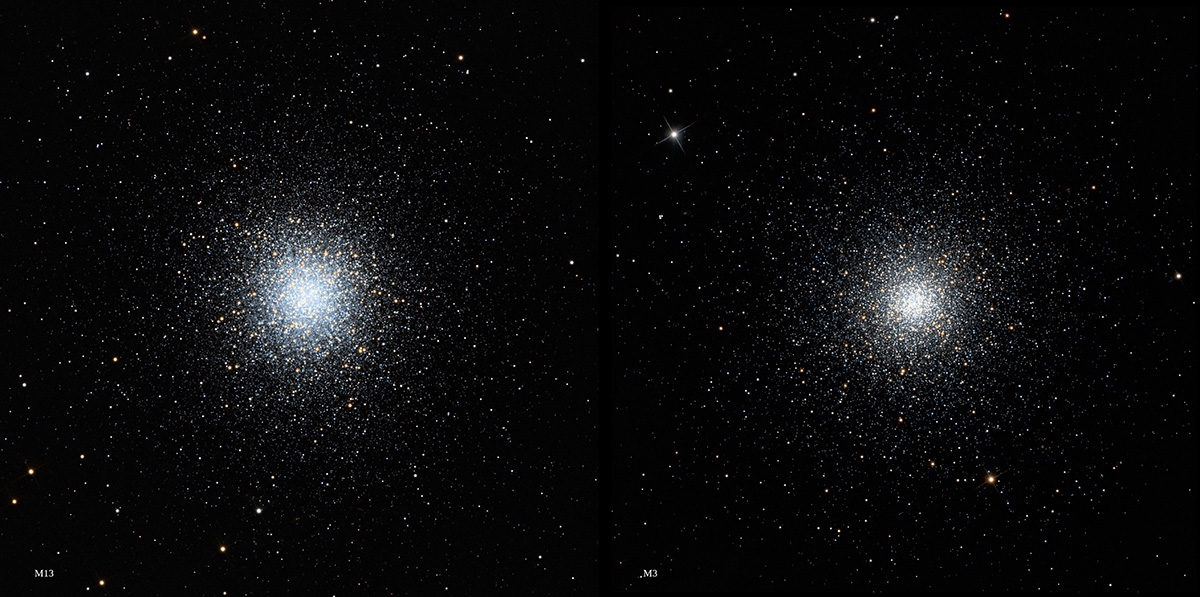
The globular clusters M13, the Great Hercules Nebula, on the left, and M3 imaged on the same night, 6th April 2026.
Details
- Rig: Player One Ares-M Pro + Tecnosky RC8 + EQ6R-Pro
- Software: NINA/PhD2/Pixinsight/Photoshop
- Filters: Astronomik LRGB
- Constellation: Hercules/Canes Venatici
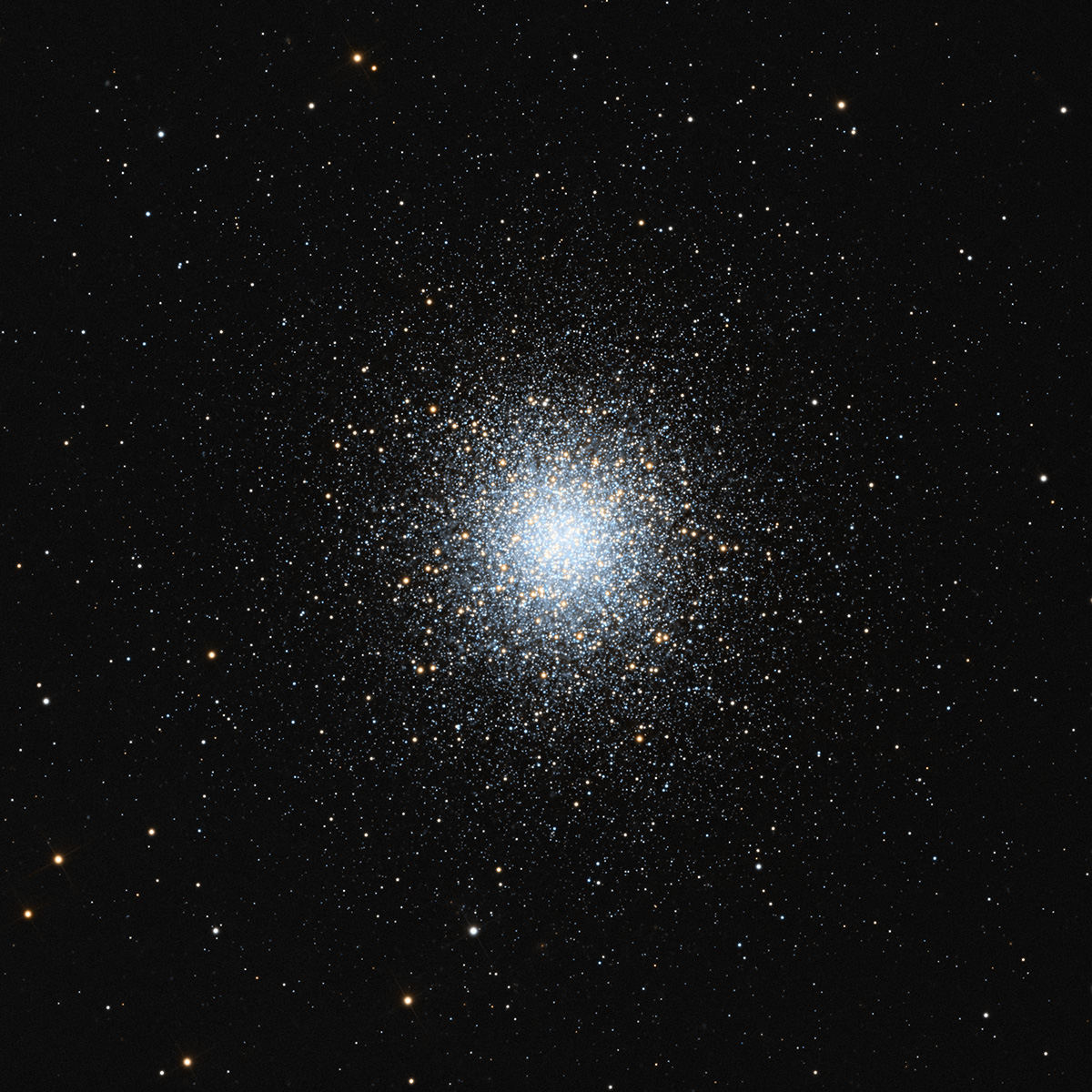
M13 -click for larger view
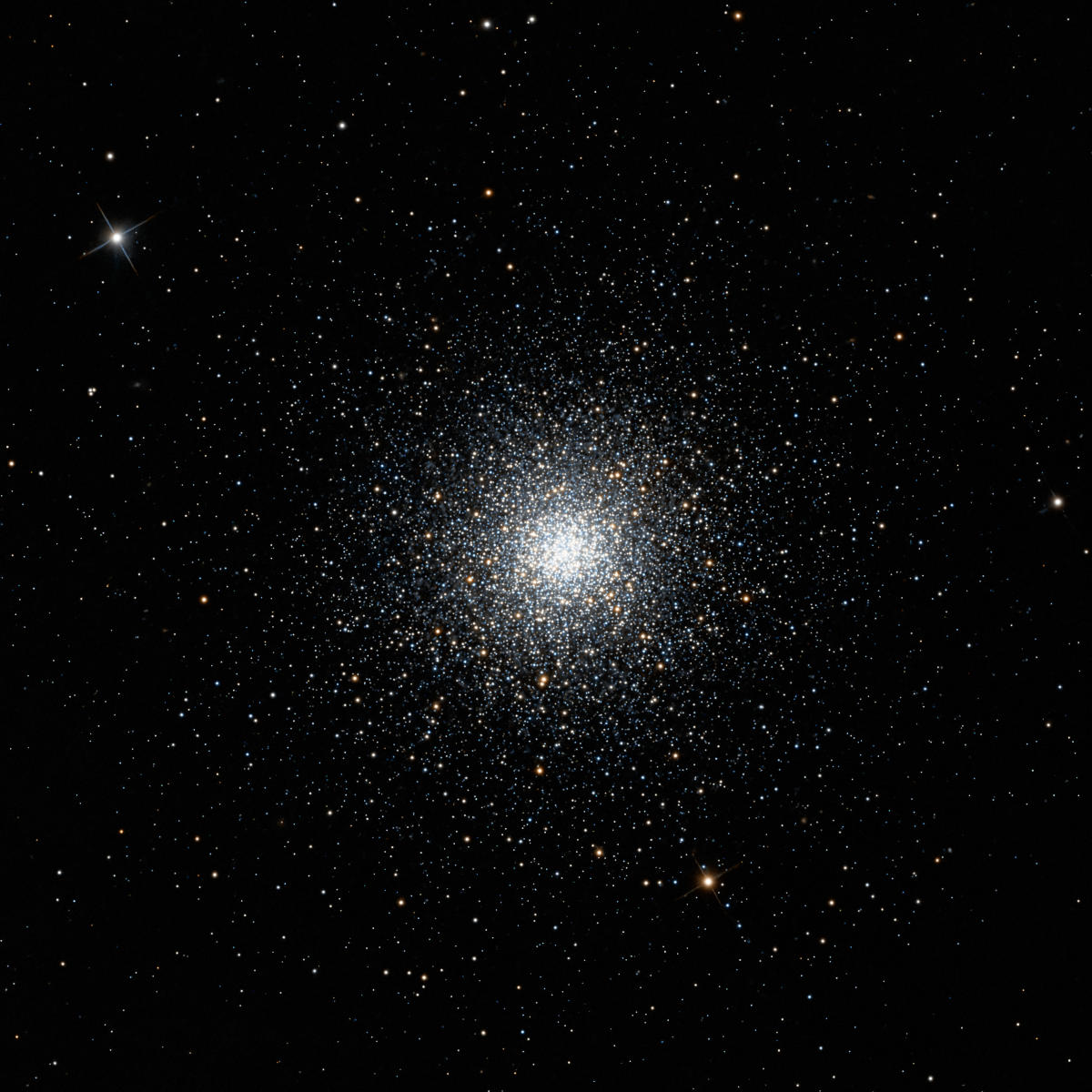
M3 -click for larger view
Notes
These two magnificent globular clusters were photographed in the same session. First, on the right M3 as it rises earlier in the eastern sky for around 90 minutes and then M13 on the left for two hours.
M13 is bigger, brighter and bolder but M3, though by no means small itself, in my view has a beautiful delicacy missing from its more renowned neighbour. M13, discovered by Edmund Halley is the closer of the two at ~23,000 light-years and has a diameter of 135 light-years or 20 arc/seconds. Its magnitude of 5.8 menas means that it can be seen with the naked eye under good skies (alas, Coventry will never fall into ths category!)
M3, with a magnitude of 6.2 and a slightly smaller diameter of 19 arc/seconds as viewed from Earth. The beautiful array of coloured stars is framed by an isosceles triangle of mag.9 stars (in this image pointing to ten o’clock on an imaginary clock face). It contians around 500,000 stars and is estimated to be 10 billion years old, more than twice the age of the Earth and certainly one of the oldest objects easily found and readily visible with amateur equipment.
Both clusters are easy to observe visually with a small telescope. Astrophotography adds an additional dimension with its ability to resolve much of the detail and the colours of the constituent stars.