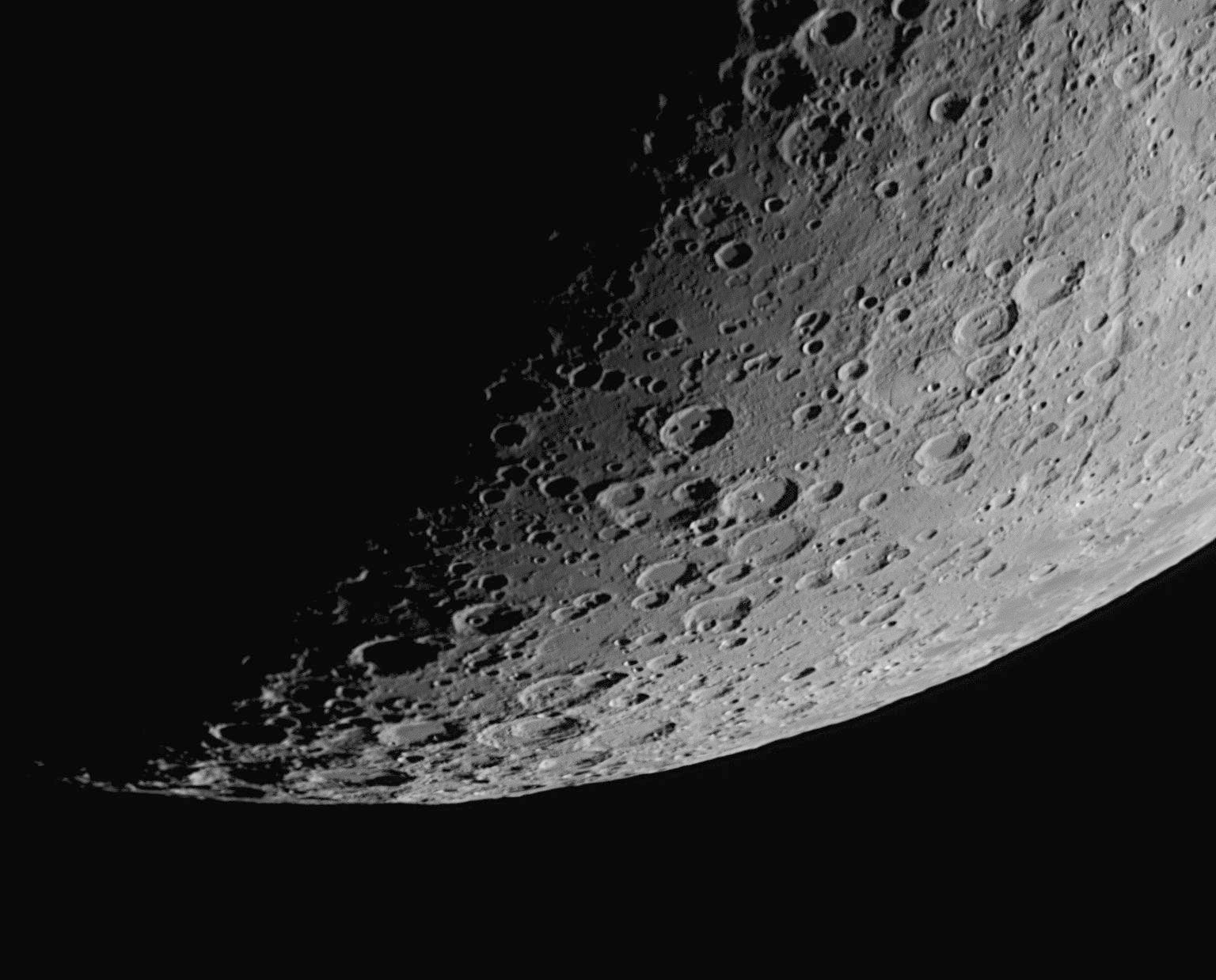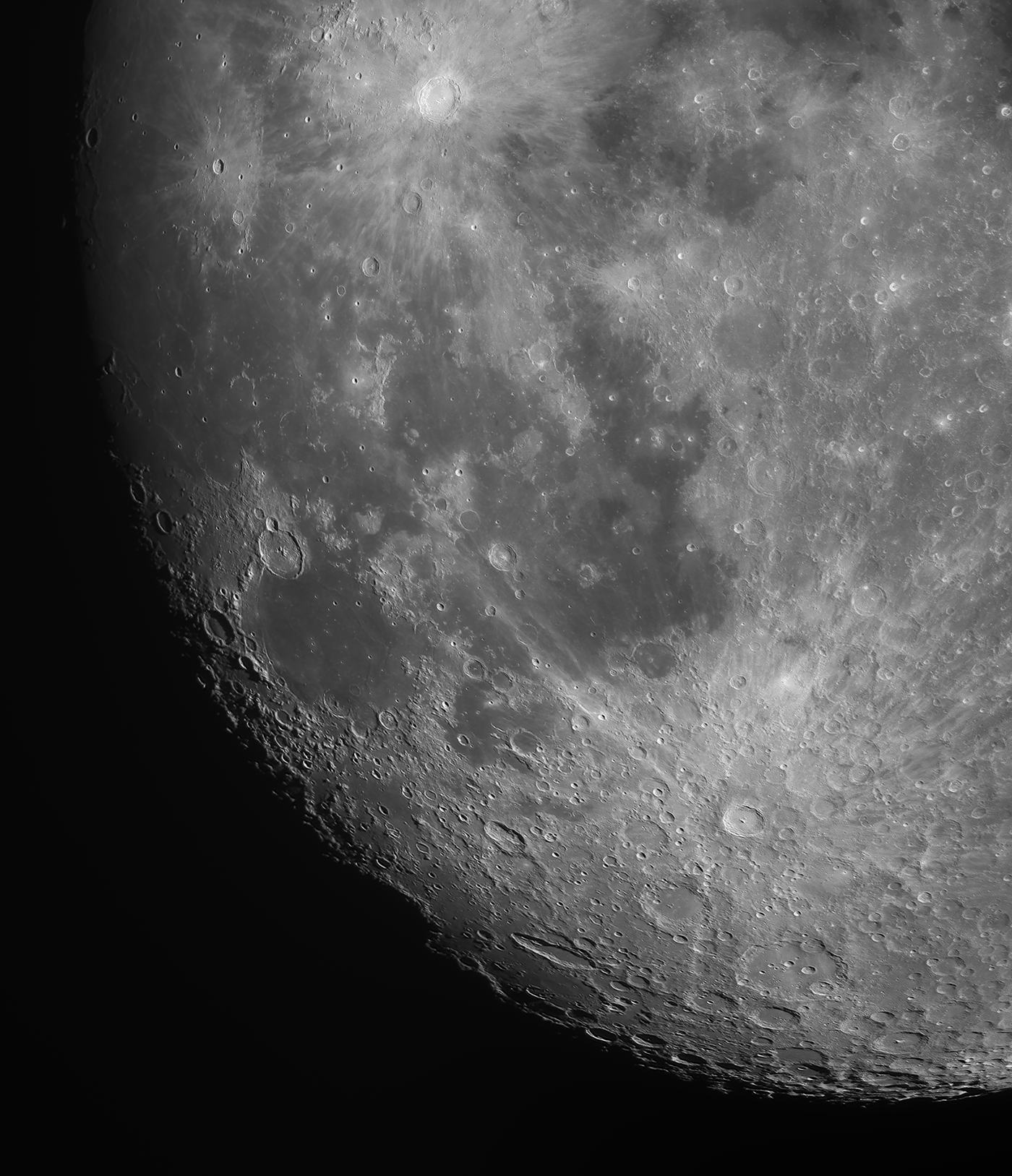
Day 11 view of the south-western sector of the Moon.
Details
- Rig: Player One Ares-M Pro + Tecnosky RC8 + EQ6R-Pro
- Software: NINA/Sharpcap v4.1/Autostakkert/Registax/Photoshop/Lightroom
- Filters: Altair Astro Planet-Killer 685nm IR Pass
- Constellation: Cancer
- Lucky imaging 20% of 1000 frames

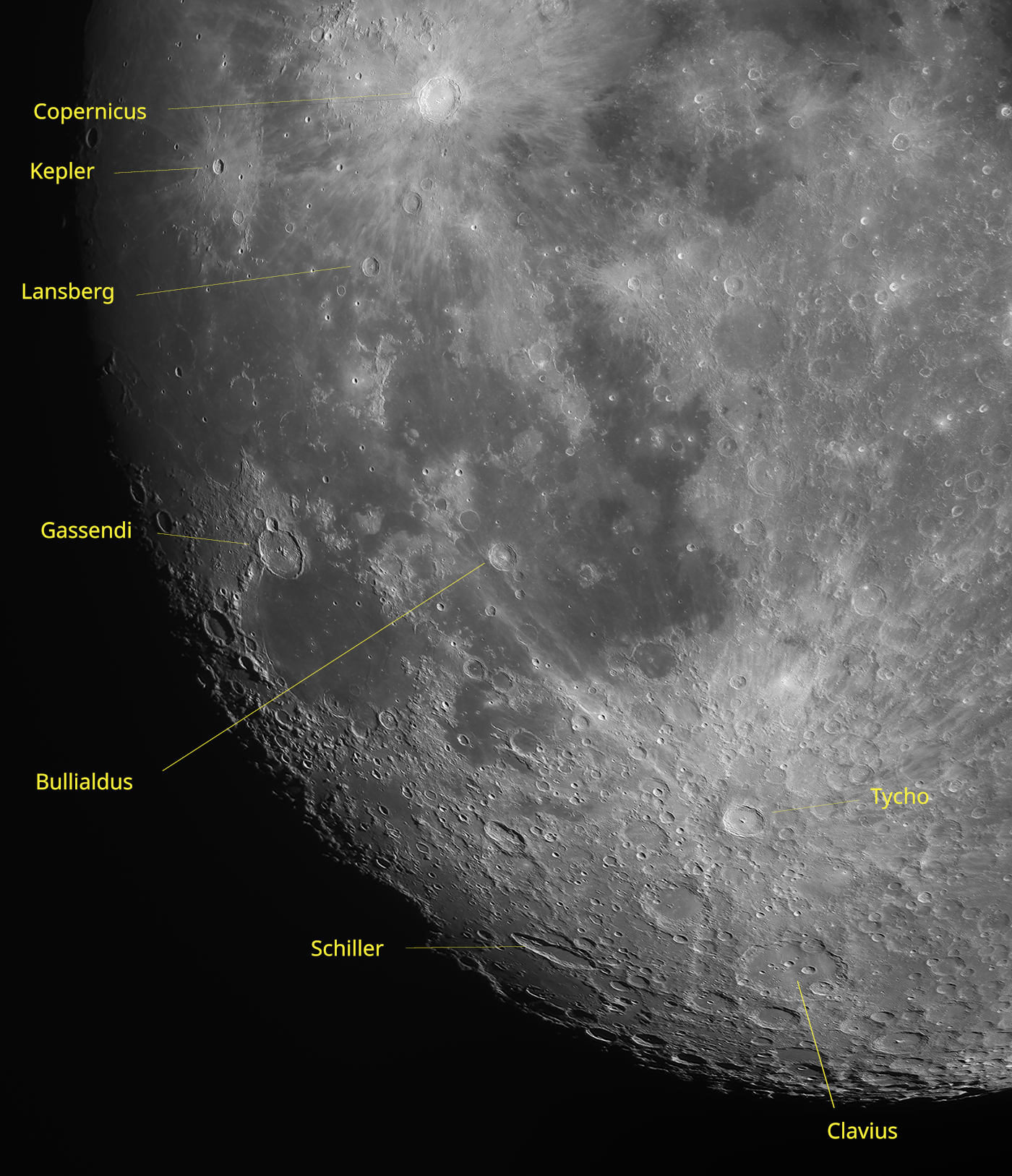
Annotated - click for larger view
Notes
The seeing this evening was much better than a few days ago which has resulted in a much sharper, more detailed image. Interesting craters are:
- Copernicus - diameter 93 km. A relatively young crater as shown by the lack of mare material within its walls (in other words, the impact occured after the laval flooding of the mare). The concentric nature of the crater walls can be seen as well as the marked radial ejecta rays.
- Kepler - diameter 32 km. The internal ridge visible running from the north wall of the crater in a south-westerly direction shows where the meteorite making impact landed partly on a rugged area. To the east of this the terrain is more mare-like and shows no raised area.
- Lansberg - diameter 39 km. The terraces of the crater walls are visible. The tops of the crater have slumped to produce a sharp edge to the rim.
- Gassendi - diameter 110km. The numerous cracks just visible here suggest there has been significant uplift of the crater floor from movement in the Moon’s crust over time.
- Bullialdus - diameter 61 km. There are several peaks in the center rising to over a kilometre in height. A raised ridge is visible here running from the peaks to the south-east, as far as the inner wall.
- Tycho - diameter 85 km. This is a fresh, “young” crater showing a clear, high, central peak. It displays a strong concentric texture which may be a sign of a fracture system caused by the impact of the meteorite which created it. Though not visible in this image, lunar orbiters have shown the floor to be extremely rough and rocky.
- Schiller - a crater thought to be made up of multiple, conjoined craters and not, as once was assumed, an oblique impact from a huge meteorite.
- Clavius - diameter 231 km, the second largest crater on the visible side of the Moon. Easily identifiable from the curving chain of internal craters. NASA found molecular water near Clavius in 2020.